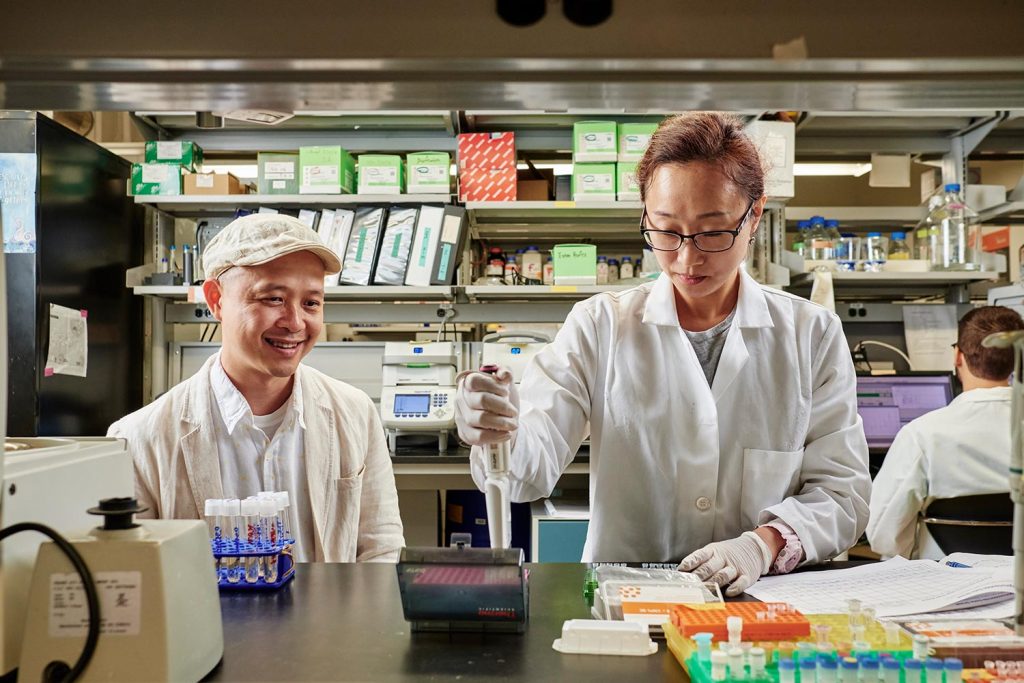
Trinh, Ryu Awarded $1.3M in NSF, NIH Grants
Single-celled yeasts in the genus Candida are normal passengers on the human body, living peacefully in our guts and on our skin.
However, people with weakened immune systems and some other conditions can experience an overgrowth of these yeasts, leading to a type of infection known as candidiasis. Most cases of candidiasis can be treated with antifungal drugs, but some species evolve so fast that they can become resistant to medications. The worst cases occur in hospitalized patients, where antifungal-resistant Candida infections can be fatal.
It might be possible to save these patients by using CRISPR, a widely-used gene editing framework, to delete the very genes that let infectious Candida resist treatment—but first, Ferguson Faculty Fellow in Chemical Engineering Cong Trinh has to discover which genes are responsible.
“Functional genomics (linking genes to the traits they control) and strain engineering (tweaking a microbe’s genes to change its traits) have applications ranging from fundamental discovery to fungal therapeutics and biomanufacturing,” said Trinh, a professor in the Department of Chemical and Biomolecular Engineering (CBE). “(But) because genetic manipulation in these (Candida) fungi is difficult, we do not fully understand how their genes dictate their functions.”
Trinh and his team recently engineered CRISPR-GRIT (guide RNAs with integrated repair templates), an extension of CRISPR which can effectively modify the type of Candida albicans that causes the most cases of drug-resistant candidiasis. The group also created Fungal Advanced Chemical Transformation (FACT), a methodology to investigate the factors that determine CRISPR-GRIT’s success, in work that will soon be published in npj Fungal Science.
Building on that success, the National Science Foundation (NSF) has awarded Trinh and CBE Research Assistant Professor Seunghyun Ryu over $900,000 to expand CRISPR-GRIT and FACT to a large number of previously unmodifiable fungal species. The team will use AI models to link insights from FACT to predict the success of CRISPR-GRIT in diverse fungi at scale for applications in fungal biology, biotechnology, and biomanufacturing.
Trinh has also been awarded a $420,000 grant from the National Institutes of Health (NIH) to identify the genes that let C. albicans develop fungicide resistance—and develop CRISPR-based antifungal treatments that make candidiasis less dangerous.
“My research associates, Dr. Ryu, and I are very grateful to the NSF and NIH for these opportunities to push the frontiers of biotechnology and AI,” Trinh said. “A unique aspect of my research program is the close link between the fundamental processes and applications, and we are excited to develop cutting-edge technologies and to pursue the scientific discoveries behind them.”
Functional Genomics at Scale
CRISPR-based strain engineering is commonly used in biomanufacturing, where microbes are tweaked to quickly produce economically or medically important compounds.
Scientists stress the target cells so they will take up new DNA sequences and gene-editing enzymes from their environment. Successful gene editing requires the target cells to survive the stress and incorporate the new sequences into their genomes. That means CRISPR platforms need to account for the particular biochemistry of the target species, especially the types of stress that cause them to accept foreign DNA.
Trinh and his team developed FACT to study how these innate traits, and environmental conditions, affect attempts to modify C. albicans using CRISPR-GRIT. Thanks to the NIH grant, they will now be able to study CRISPR-GRIT more deeply, investigating the molecular mechanisms that regulate genome editing in C. albicans—and using those results to more effectively study the functional genomics of antifungal resistance in that species.
Their molecular understanding will translate to their NSF study, where the researchers will use experiments and an explainable AI model to link molecular traits to CRISPR-GRIT outcomes in a wide variety of fungi, performing functional genomics faster than ever before.
“(This) model helps us prioritize experimental conditions that yield the best transformation outcomes, regardless of fungal species,” Trinh said. “Such a capability is essential for high-throughput, genome-scale functional genomics, scalable biomanufacturing, and the development of fungal therapeutics” like control strategies for drug-resistant candidiasis.
Both grants include funding for undergraduate and graduate students and postdoctoral researchers, who will receive interdisciplinary training in cutting-edge fungal biotechnology and genome engineering.
“The potential impacts (of this research) are significant,” said Trinh. “Our technology will advance fundamental science, disseminate new knowledge and tools, enable practical applications, and inspire and train students to work across fundamental science and applications.”
Contact
Izzie Gall (egall4@utk.edu)