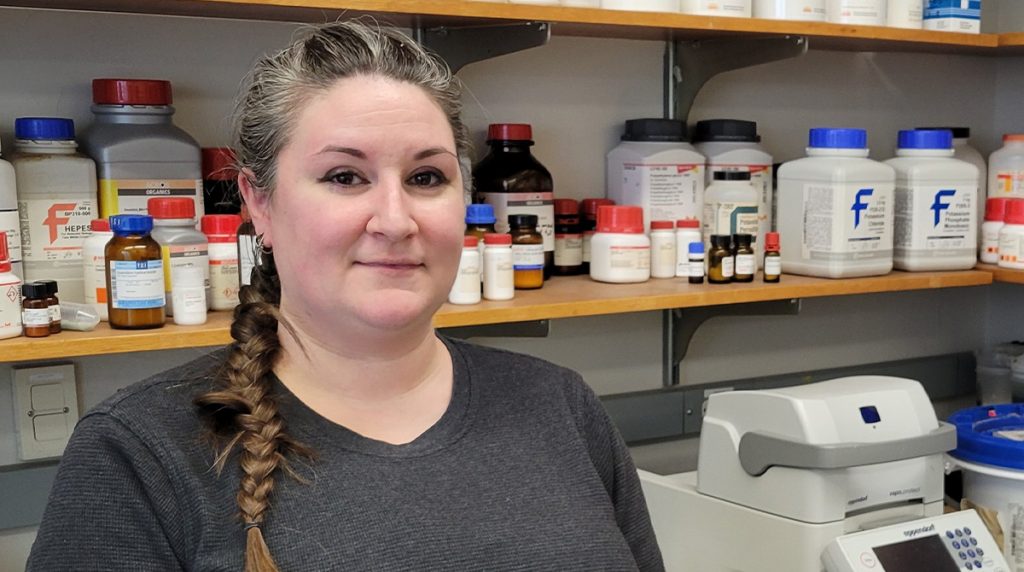
Reducing Inflammation is Denman’s Fascination
Desirée Denman has researched the human inflammation response in government, industry, and academic labs.
“I’ll take any good opportunity to learn or grow, so I’ve kind of bopped all over,” Denman said, “but inflammation seems to be the recurring theme in my life.”
During a fellowship with the Food and Drug Administration (FDA), Denman discovered that her passion for biological detail could help her fill an important need.
“The environmental engineering lab whose samples we processed was having trouble hiring a molecular biologist,” she said. “There’s a lot of engineering work that requires molecular biology and microbiology, but molecular biologists don’t go into engineering programs.”
Denman resolved to become the exception. In 2022, she joined the Department of Chemical and Biomedical Engineering’s (CBE) doctoral program.
“UT was one of the few programs willing to support somebody in an engineering PhD who does not have a hard engineering background,” Denman said.
According to Associate Professor Paul Dalhaimer, Denman’s PhD advisor, that’s because UT recognizes the importance of complementary skills.
“Good things come from synergies and collaborations,” Dalhaimer said. “Desirée is a careful planner and a meticulous scientist. She brings a different skill set that is often absent in engineering, and we are providing her with a new system for her to apply her background to.”
From Stem Cells to Macrophages
Denman earned her bachelor’s degree in microbiology, molecular biology, and biotechnology from the University of Central Florida, then worked for several years at a stem cell storage and genotyping facility in Panama.
She returned to the United States to pursue a master’s degree in immunology and infection from the University of Texas Health in San Antonio. Her master’s thesis investigated treatments that can reduce inflammation in stem cells that have been exposed to high levels of oxygen, such as those in premature babies’ lungs.
One promising treatment used caffeine to trigger the stem cells to release anti-inflammatory cytokines (signaling molecules). Those cytokines led nearby macrophages—immune system cells that usually respond to and destroy foreign particles—to initiate cell repair.
“Most people don’t think about macrophages’ anti-inflammatory ability,” Denman said, “but it is of equal, if not greater importance than getting rid of a pathogen in the first place.”
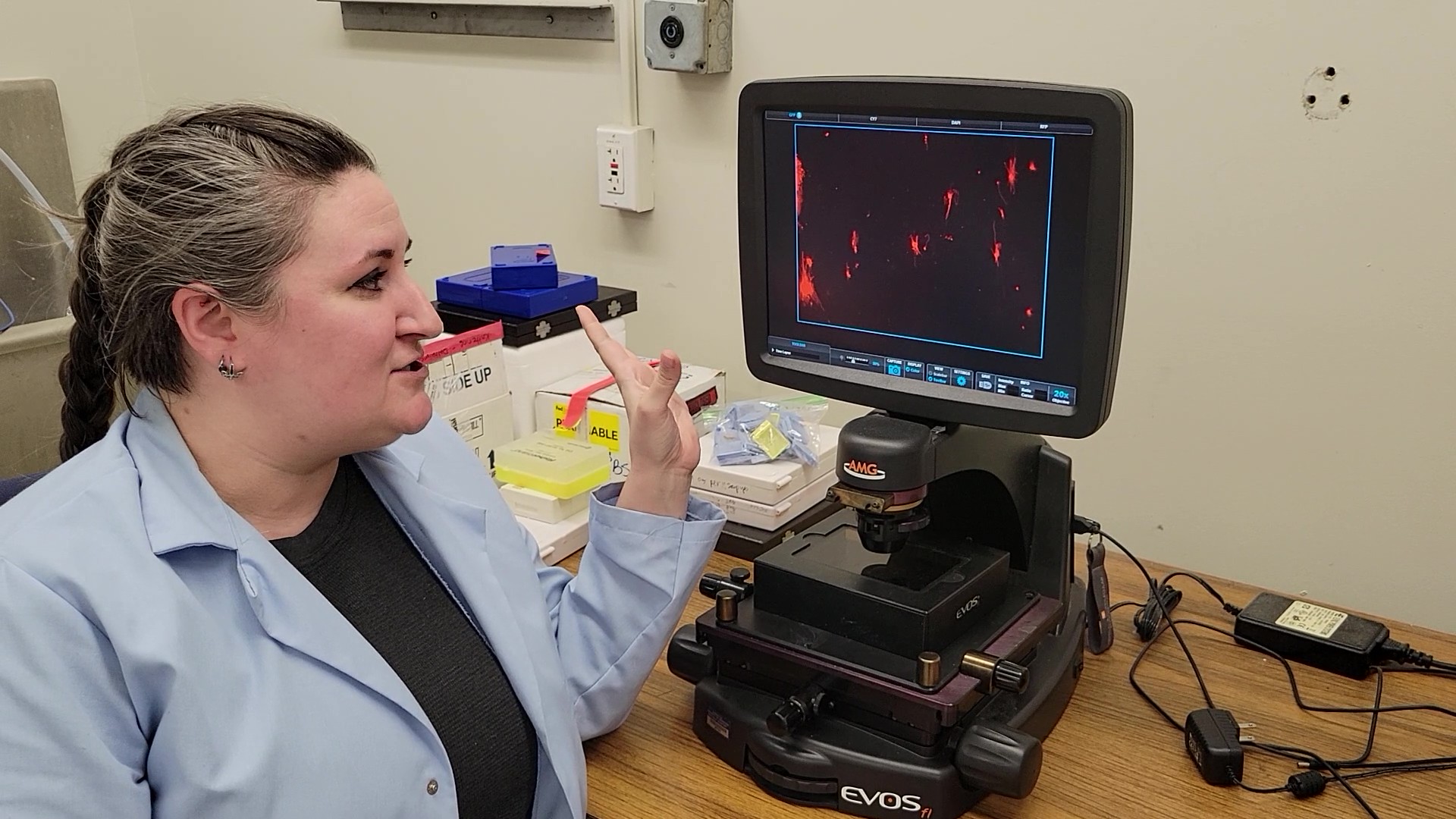
After completing her master’s degree, Denman conducted an FDA fellowship investigating how to stop the deadly ‘cytokine storm’ experienced by patients with severe COVID-19 infections. Blocking inflammatory cytokine receptors can keep patients alive long enough to fight infection. But while some cytokine blockers work as intended, others targeting the same cell receptors can instead make inflammation worse.
“The idea that different molecules can bind to the same receptor and cause completely opposite effects is not highlighted as much as it should be in biology education,” Denman said. “Caffeine is a great example. As we go throughout the day, adenosine molecules build up in our system, bind to adenosine receptors in our brain, and make you sleepy. That’s what tells your body that the day is ending. Caffeine binds to the exact same receptors, but has the opposite effect.”
As a member of the Dalhaimer Lab, Denman is now investigating this divergent effect from another angle—researching how one molecule might cause different immune responses depending on which receptor it binds.
Different Receptor, Different Effect?
Scientists have long believed that nanoparticle (NP) medications become engulfed by macrophages in the same way as large foreign particles like infectious bacteria, triggering an inflammatory response before being destroyed.
But the Dalhaimer Lab recently discovered that poly-ethylene-glycol (PEG), an NP that has been considered inert for decades and is commonly used as a pill coating, is taken up by a different mechanism after binding a macrophage surface receptor. One of the team’s studies, published in 2024, indicates that PEG itself could be used as an anti-inflammatory drug.
“Right now, we know that PEG binds to certain macrophage receptors, but we don’t know what that binding leads to,” Denman explained. “We think that by interacting with these other receptors, PEG and PEG-bound NPs might trigger different immune pathways in the macrophage—maybe even anti-inflammatory pathways. Maybe this inert particle could help regulate and improve immunological function without causing a whole bunch of side effects.”
Denman and other members of the Dalhaimer Lab are currently investigating the effects of PEG injection on inflammatory cytokine levels in mice. The researchers are also checking gene activation markers to determine what kinds of immune pathways trigger when the NPs bind to macrophages.
“If it works, we’ll have these NPs that bind macrophages and reduce systemic inflammation without causing a whole bunch of side effects,” said Denman. “It’s not going to be the cure-all solution to inflammation; the immune system is too complicated to say that. But it’s going to be another piece of the puzzle.”
Contact
Izzie Gall (egall4@utk.edu)